Training in Rome: Experiencing Religious Culture through Music and Manuscripts
How can medieval music and manuscripts become tangible sources for understanding religious culture today? A recent RESILIENCE training in Rome demonstrated how combining sensory experience, digital tools, and hands-on methods opens new perspectives for studying cultural heritage.
Learning to Experience, Not Just Study
The training “Visions of Italy: How to Hear, Read, and Experience Religious Culture through Medieval Music and Manuscripts” formed part of a two-week course on cultural heritage in Italy organised by the Catholic University of America (CUA). The course explores how cultural heritage institutions such as libraries, archives, and museums operate, and how they communicate their collections to different audiences.
Against this backdrop, the Catholic University of America specifically requested a dedicated RESILIENCE training for its programme at the Rome Center. This request reflects the fact that RESILIENCE Work Unit Training has developed, during the Preparatory Phase Project, training formats that are transferable and broadly applicable to diverse target groups in the study of religions and cultural heritage.
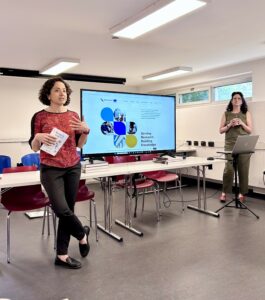
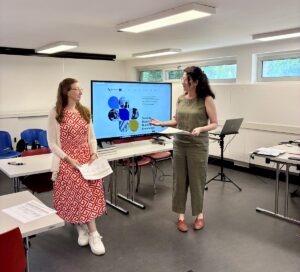
RESILIENCE organised and delivered the full-day training in May 2026 in Rome for a group of 19 graduate students from CUA Washington, DC, who are specialising in “Cultural Heritage Information Management”, led by Maria Mazzenga (CUA; visual below, top row, far right). The training complemented their academic programme by adding an experiential and methodologically integrative perspective on cultural heritage.
Bridging Disciplines: Music, Manuscripts, and Digital Methods
The training highlighted the value of combining different disciplinary perspectives. Participants were introduced to medieval musical traditions, manuscript culture, and the broader social and religious contexts in which they emerged.
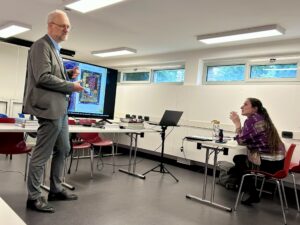
The musical component of the training was led by Gioia Filocamo (Conservatorio di musica “Giulio Briccialdi” di Terni; University of Parma; visual above), who guided participants through medieval repertoires and their cultural contexts.
By engaging with medieval musical repertoires and manuscript sources, participants gained a richer understanding of how religious culture was produced, transmitted, and experienced. At the same time, the training demonstrated how digital tools and databases can be used to identify, access, and analyse such sources in contemporary research environments.
This combination of historical insight and digital methodology helped participants recognise both the possibilities and the limits of working with cultural heritage data, including the challenges posed by incomplete or lost sources.
Practical Skills with Immediate Relevance
A key benefit of the training was its practical orientation. Participants worked directly with sources and methods, developing skills that are immediately applicable in both academic and professional contexts. The inclusion of musical listening and discussion elements added a sensory dimension, encouraging participants to reflect on how perception shapes interpretation.
They engaged with manuscript databases and digital research tools, learned how to contextualise and interpret historical materials, and practised reading and transcribing medieval scripts. The manuscript training was led by Christoph Winterer (Wissenschaftliche Stadtbibliothek Mainz; visual below, top row, left), who introduced participants to manuscript research, cataloguing practices, and transcription techniques.
The integration of practical exercises and critical reflection provided participants with a toolkit that can be applied in research, as well as in libraries, archives, and other cultural heritage environments.
Rethinking Cultural Heritage through Experience
The training encouraged participants to reflect critically on how cultural heritage is studied and communicated today. Through direct engagement with music and manuscripts, they explored how meaning is created, transformed, and sometimes lost over time.
Insights from the reflection session showed that participants particularly valued understanding music as a social and symbolic practice, observing the development of artistic forms in manuscripts, and gaining awareness of how digitisation changes access to cultural heritage. At the same time, they recognised the importance of acknowledging gaps in historical knowledge and of working constructively with fragmentary evidence.
Further Resources
The RESILIENCE Key Recommendations for designing and delivering future training formats, as well as an Training Needs Assessment Plan and more can be found in the RESILIENCE Training Management Plan (Deliverable D2.6).
The broader development and evaluation of training formats are documented in the RESILIENCE Training Management Report (Deliverable D2.13).
Together, these resources provide a foundation for advancing high-quality, evidence-based training in the study of religions and cultural heritage.
See also Training Management Report Published.