Impact
RESILIENCE is preparing services and services will lead to impact in several areas. Curious how that works? You can read more on this page.
From Services to Impact
The mission of RESILIENCE is to improve research by offering digital and physical access to data, advanced tools, trainings, and expertise. Through these services, the research infrastructure helps researchers to collaborate, discover new knowledge, and use modern digital methods in the study of religion. This is especially important because the field is today strongly affected by digital transformation, but not all researchers have the same access to technology or materials. RESILIENCE wants to reduce this inequality and support more open, innovative, and interdisciplinary research.
As we see it, the main impact of the research infrastructure comes from its services, because services directly reach users. Governance and internal organisation are still important, but their influence is indirect. Therefore, this Plan focuses on measuring how services create change: for example, through better data access, more trained researchers, or stronger international cooperation.
Our Impact Anlysis, D5.1, creates a clear strategy for proving that RESILIENCE is a valuable investment for Europe. It shows how the reseach infrastructure will support scientific excellence, digital innovation, cultural heritage, social inclusion, and evidence-based policymaking. By building connections between science and society and by making knowledge about religion more accessible and useful, RESILIENCE aims to support a more informed, democratic, and respectful European future.
Stakeholders and Beneficiaries
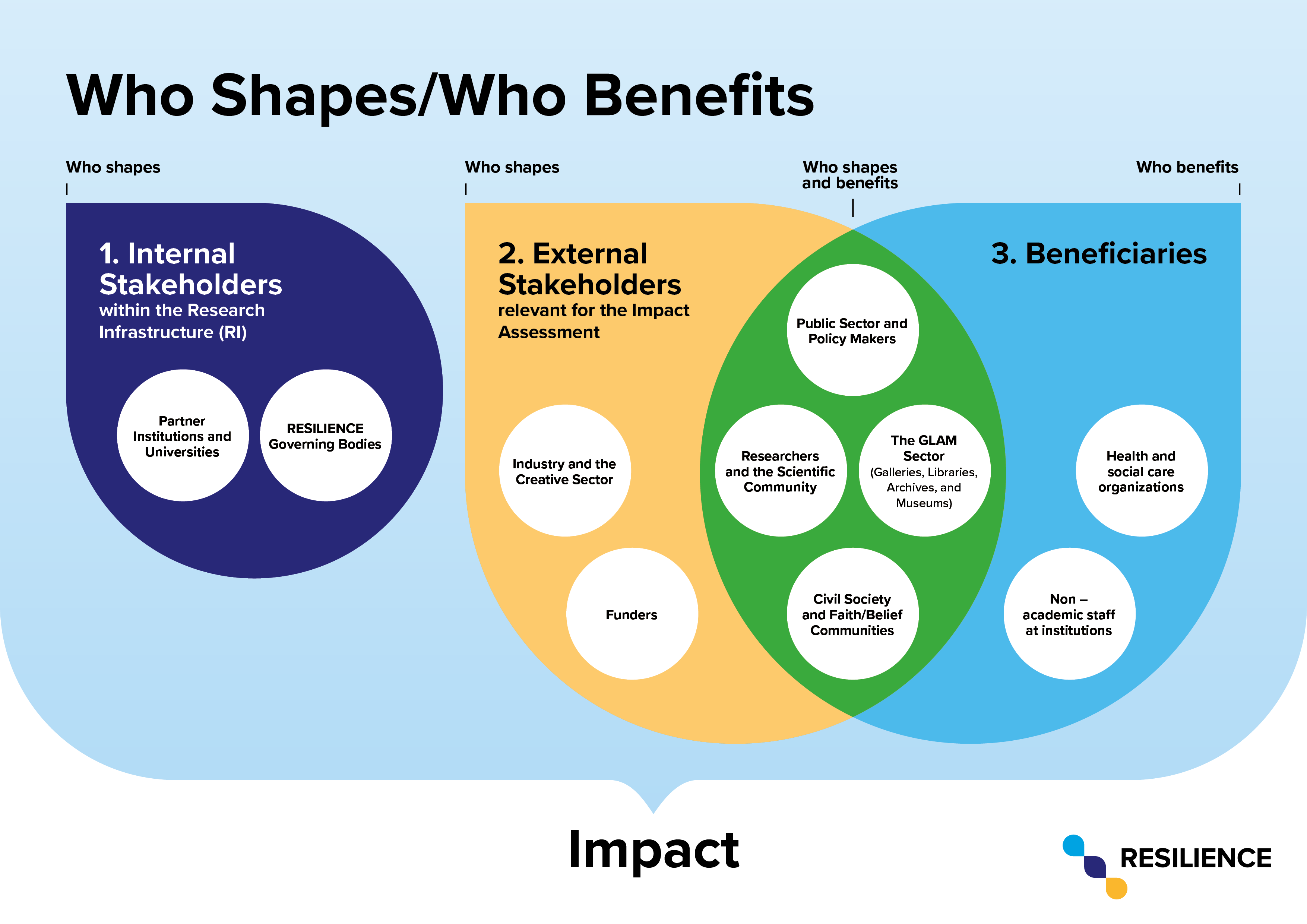
In the context of RESILIENCE, the distinction between stakeholders and beneficiaries is not always clear-cut. Certain groups, such as academic institutions, cultural organizations, and public authorities, act both as stakeholders who shape the infrastructure and as beneficiaries who directly use its services. The stakeholders relevant for the RESILIENCE Impact Assessment can be divided into internal and external groups. Each group plays a key role in ensuring that the infrastructure delivers measurable impact.
RESILIENCE Impact Pathway Model
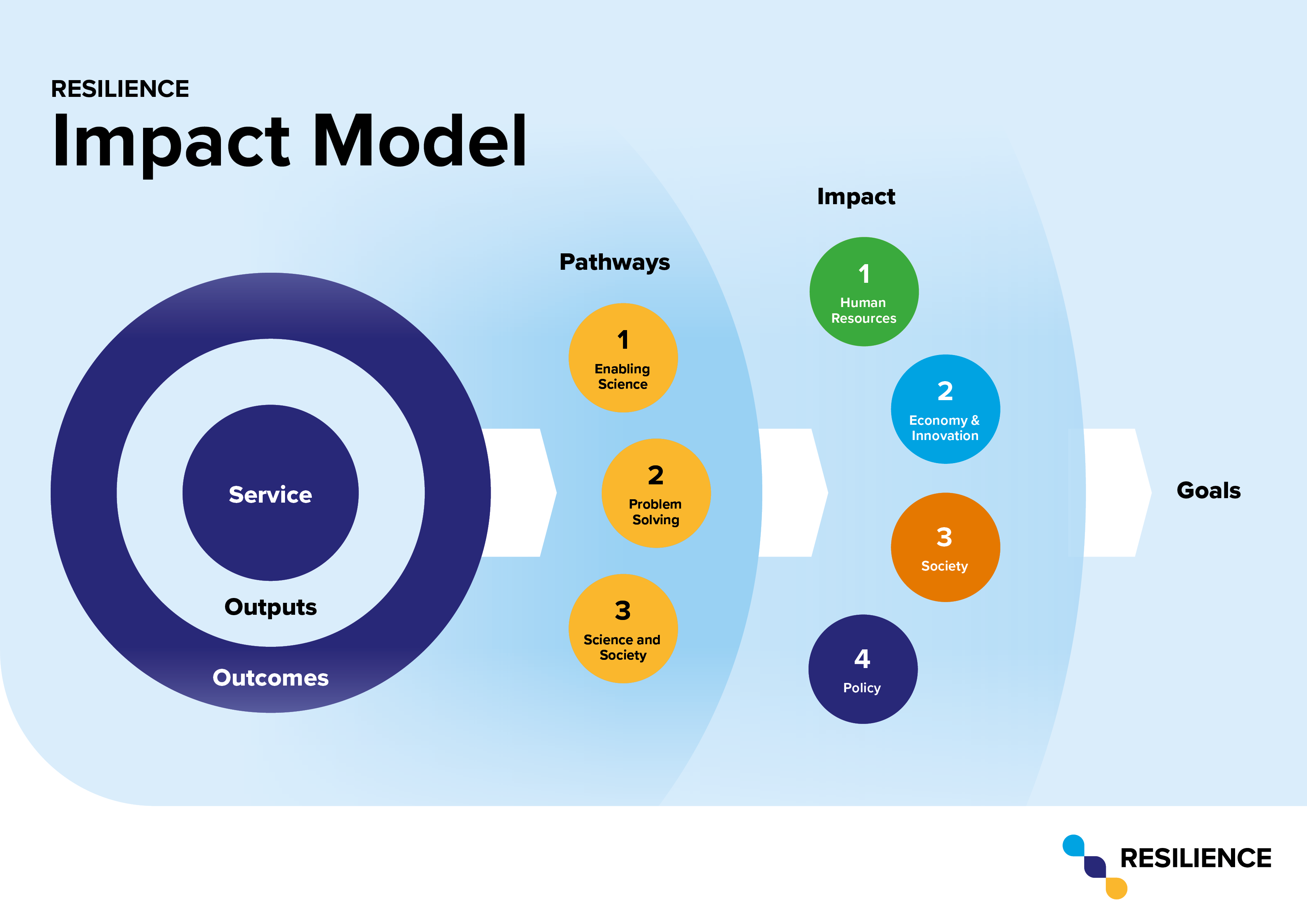
The impact-pathway model follows the RI-PATHS guidelines, implying that each activity contributes to change at multiple levels. The model is presented eco-centrically, drawing on Bronfenbrenner’s ecological systems theory. At the centre are the goals of the future research infrastructure and the services (activities) delivered through it; all flows converge toward these goals, which are also reiterated in the outer ring to emphasise their system-wide relevance. Effects of delivered services are traced as outputs, outcomes, and, ultimately, impact. At the service/activity level this includes elements intrinsic to the research infrstructure, such as transnational access (TNA), training modules, and digital user services developed within the project.
Research Infrastructures generate impact through three overarching areas—Enabling Science, Problem Solving, and Science & Society—each articulated as a pathway that links concrete RI activities to observable, measurable changes. Across all pathways, impacts are tracked within four domains—Human Resources, Economy & Innovation, Society, and Policy —which serve as a common schema for indicators and evidence. A pathway operates like a testable hypothesis: if specific services (e.g., transnational access, training, digital tools) are delivered to defined users in a given context, then defined effects should follow over time. A rsearch infrastructure’s impact model, therefore selects a small number of priority pathways aligned to its mission and users, and maps them onto strategic impact areas.
Across all pathways, results are captured across four socio-economic impact domains: Society, Policy, Economy & Innovation, and Human Resources. The socio-economic impact of the RESILIENCE Research Infrastructure is essential because it demonstrates how investment in the study of religion contributes not only to academic knowledge but also to broader societal well-being. In a field often perceived as predominantly theoretical, RESILIENCE delivers tangible value through support for cultural-heritage preservation, education, digital innovation, and intercultural understanding—domains with direct relevance for social cohesion and the resilience of democratic life. To ensure this impact assessment framing becomes operational, the RESILIENCE Impact Assessment Plan specifies a theory-driven chain that links inputs and activities to observable changes and long-term effects.
More
Our Impact Analysis, Deliverable D5.1, gives a deeper insight into the impact that is envisioned and explains how RESILIENCE will measure and show its contribution to research, society, economy, and policy once it becomes fully operational.